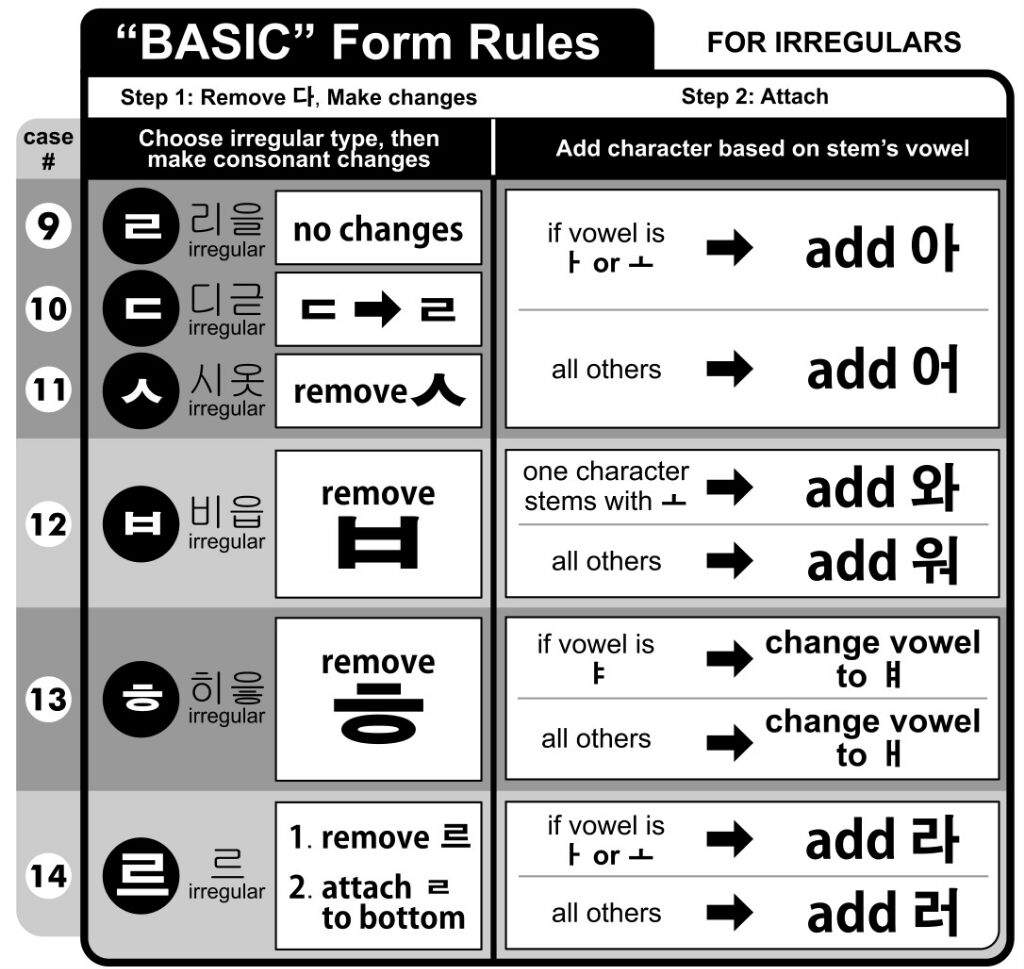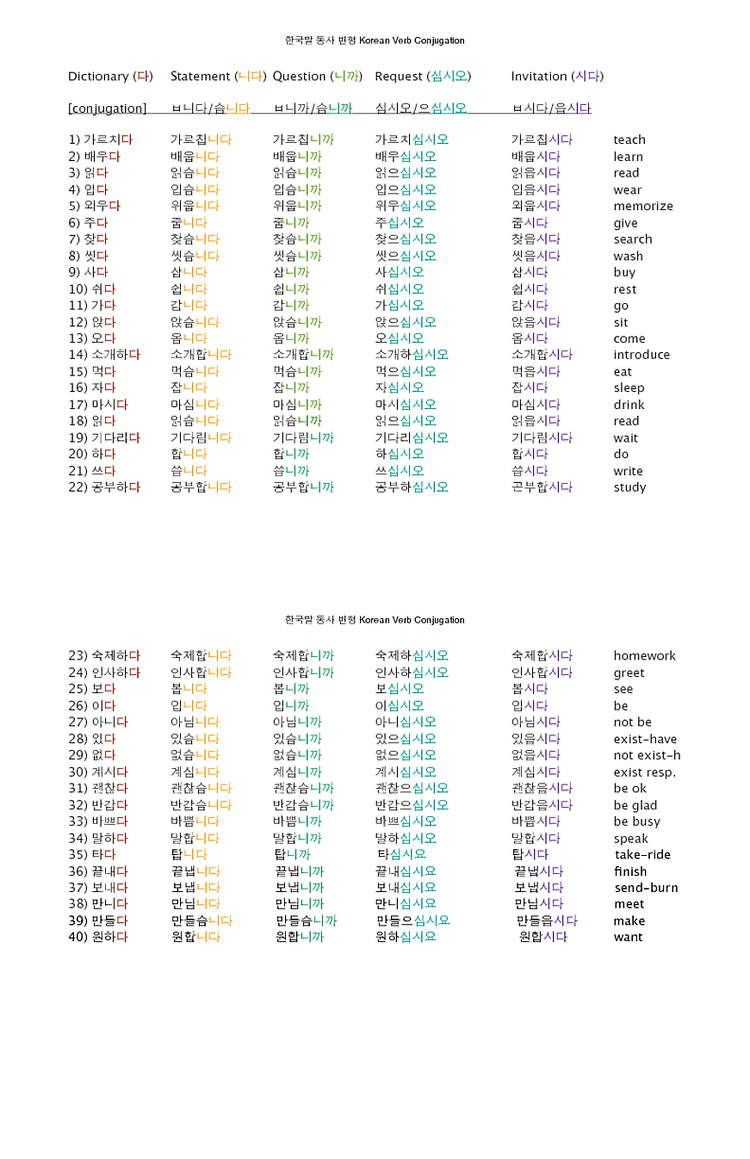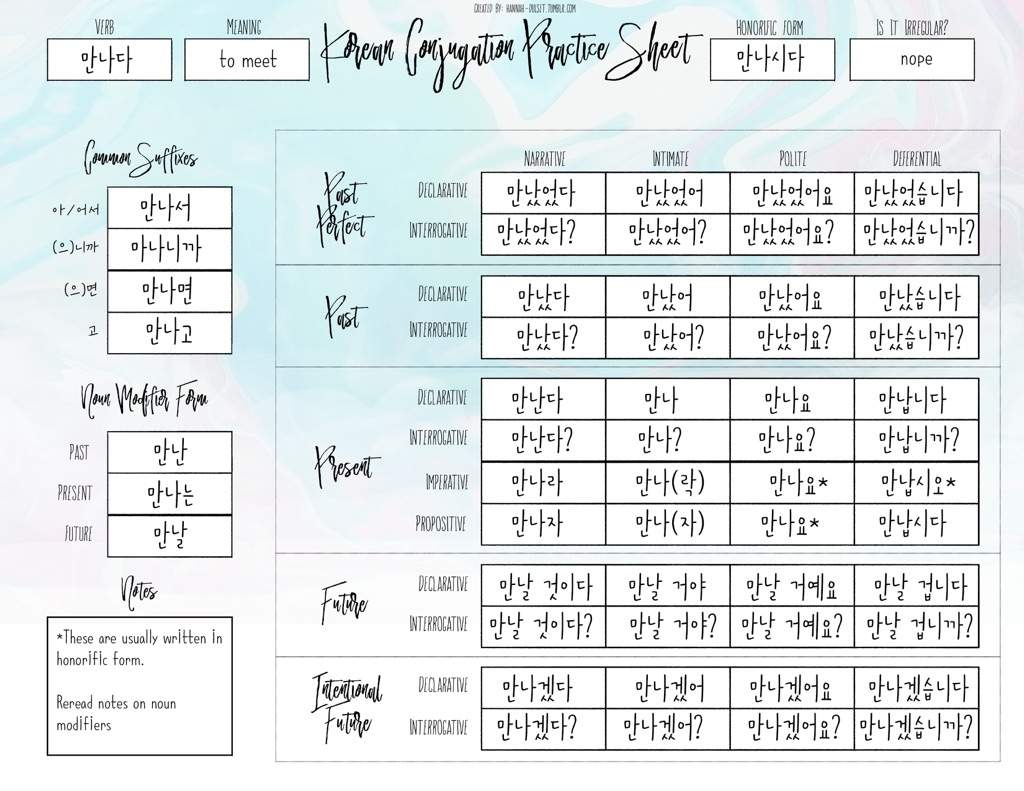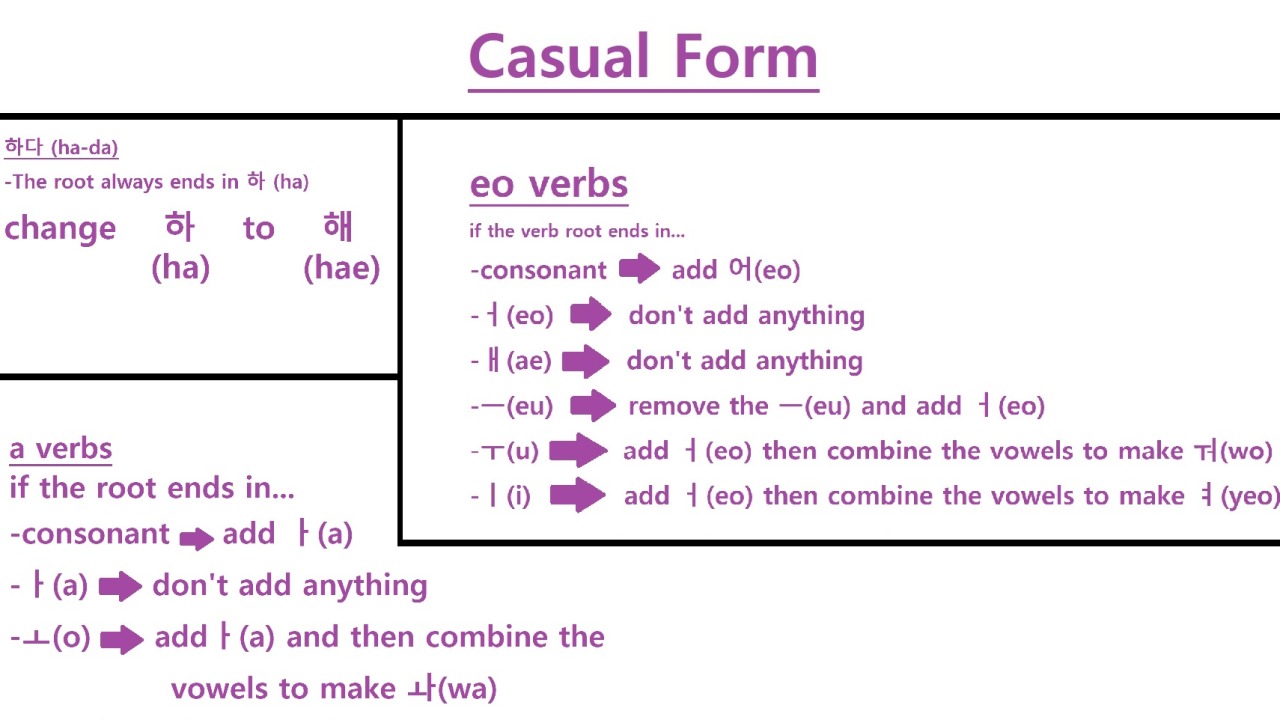
Using our “conjugation tables,” you can see the many ways a verb or adjective can change depending on the grammatical “addition” that is added to it. There are many grammatical additions in korean, and each has its own way of changing verbs and adjectives. Each time a new format/style of addition is introduced, i explain how irregular.
Today, we’re going to learn korean irregular verb ㄹ conjugation ‘ㄹ’ 불규칙 (‘ㄹ’ irregular conjugation). This lesson has four parts: First of all, we’re looking at when the adjective/verb stem that ends with ‘ㄹ’ meets the verb ending that begins with ‘ㄴ, ㅂ, ㅅ. ’.
Second, when the final consonant ‘ㄹ. 배우다 (to learn) 만나다 (to meet) these are regular verbs as they can be easily conjugated using the different korean verb conjugations. This also applies to korean adjectives.
How to conjugate verbs in present tense (korean)related lessons:how to make sentences in korean: Korean only has three tenses: Present, past and future, but they also express the progressive and perfect aspect through verb conjugations.
The verb stem, the dictionary form, and the informal polite form are all used to conjugate korean verbs. When conjugating a verb in korean, the is removed from the verb stem or the word's dictionary form before the proper conjugation patterns are added. The verb tense affects the conjugation patterns (past tense, present, and future).
Conjugation in korean is a term that refers to the way verbs and adjectives are changed from their base form. By conjugating a korean verb or adjective into a new form, you can change the tense, politeness level, and the usage of that verb or adjective. Conjugation is not just a feature of the korean language.
As mentioned earlier, conjugations of verbs in korean happens by dropping the 다 verb endings from the verb stem. For the verbs 자다 and 먹다, we’ll need to drop the 다 verb endings which will make them: If the final vowel after dropping 다 is either ㅏ or ㅗ, you’ll use 아요.
But if the final. As you learned above, the first thing you do is drop the 다 to make the basic verb stem ( 가 ). As you can see, the final vowel in the verb stem 가 is ㅏ, so we must add 아요 to make the present tense (see rule 1 above).
However, in this example, 가 + 아요 does not make 가아요. Instead, the correct conjugation is 가요. The basic way to conjugate a korean adjective is by removing 다 from the word.
You will then be left with the verb stem. The next step is to add the appropriate ending (~ㄴ/은/는) to the verb stem. Thus, in the korean language, rather than separate korean verbs and adjectives, there are action verbs (verbs) and descriptive verbs.
How to conjugate past tense korean verbs casual formality verb + 았어 or 었어 polite low formality verb + 았어요 or 었어요 polite (high formality) verb + 았습니다 or 었습니다 The verb we are going to deal with first is 가다 (gada) which means to go. This is the basic form of the verb to be able to use it in a sentence we need to conjugate it.
To conjugate 가다, you need to take away 다. So now you are left with the stem, 가. 8 rowsas you already know, a sentence must end in either a verb or adjective or 이다.
Let’s look at how. Korean verbs in the present tense do not conjugate for each person. This means that the verb stays the same for ' i ', ' you ', ' he ', ' they ' etc.
This is similar to the case in english. There is however a verb ending for the familiar form and a different verb ending for the respectful form. Notice how in korean, the verb stayed exactly the same, while it changed in english.
In korean, you only really have to conjugate the verb considering tense, which makes it a much easier process than in english. I’ll go over a couple more korean verb basics, and then have a look at how to actually conjugate verbs. 하다 (hada) basically means ‘ do ‘.
But it’s used as ‘do’ and ‘be + adjective’ (descriptive verbs instead of adjectives). There are 2 types for 하다 verb conjugation. Based on chinese words or onomatopoeias, 2.
Based on pure korean. It’s decided depend on roots but let’s focus only on conjugations in this lesson. Let’s use the korean verbs 자다 (jada) and 먹다 (meokda) as an example.
These 2 korean verbs are both in their verb stem form. As mentioned earlier, verb conjugations in korean happen by dropping the 다 verb endings from the verb stem. For the korean verbs 자다 and 먹다, we’ll need to drop the 다 verb endings which will make them: